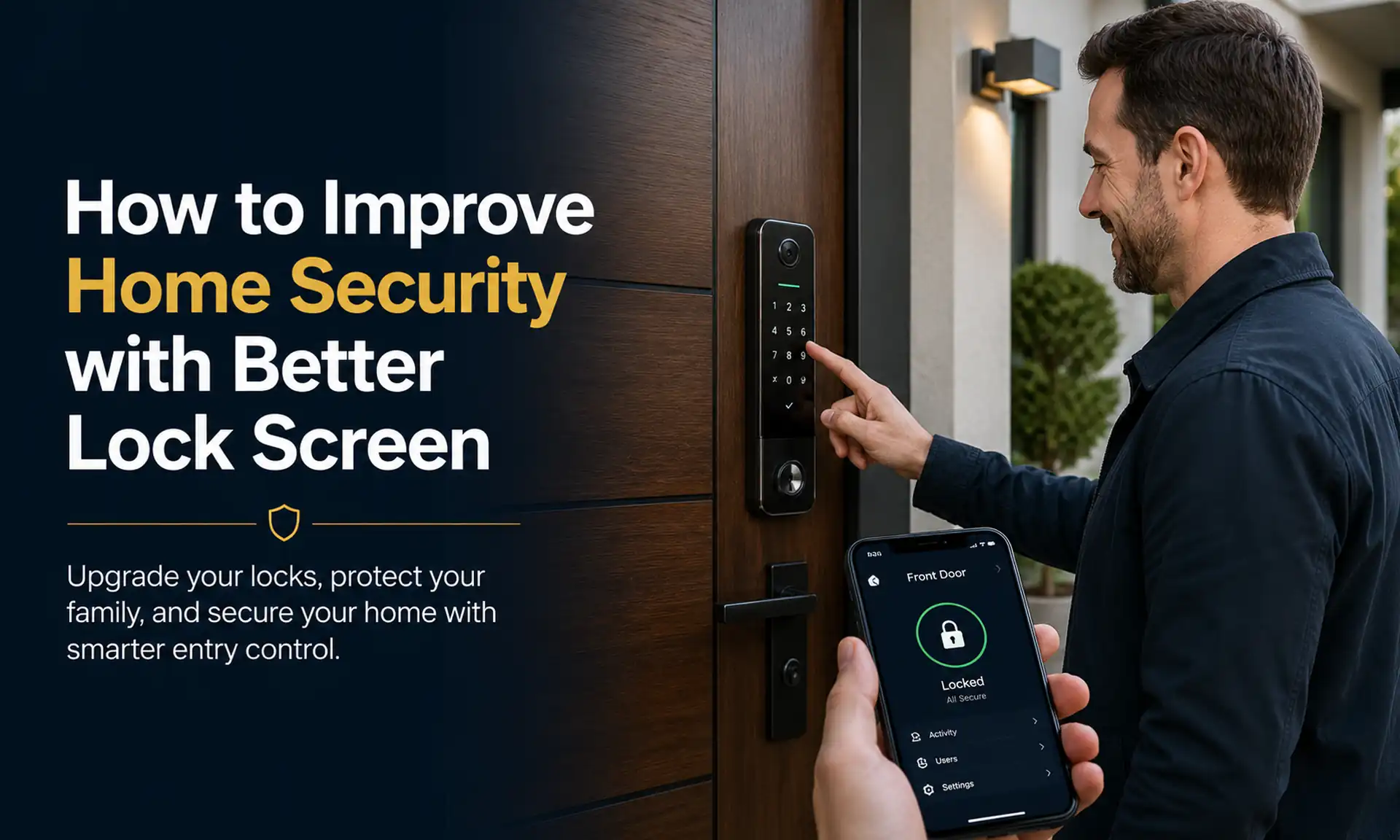
How to Improve Home Security with Better Lock Screen? You can improve home security with better lock screen protection by using strong door locks, solid door frames, secure screens, window locks, and smart safety tools together. A good lock helps, but the whole entry point must stay strong. This guide shows you what to check, what to upgrade, and where to start.
Why Better Locks Matter for Home Security
Your front door is one of the main ways people enter your home. A weak lock can make that door easier to force open.
Better locks can help you:
- Slow down forced entry
- Make the door harder to kick open
- Control who can enter
- Avoid hidden spare keys
- Track entry with some smart locks
- Feel safer when you are home or away
Still, a strong lock cannot do all the work alone. The door, frame, hinges, strike plate, windows, and screens also need to stay strong.
Think of your home as a group of entry points. If one part stays weak, a burglar may choose that spot instead.
How to Improve Home Security with Better Lock Screen Protection
The best way to improve home security with better lock screen protection is to strengthen every part around the lock.
Start with these areas:
- Use a strong deadbolt.
- Reinforce the door frame.
- Upgrade the strike plate.
- Check the hinges.
- Add a strong security screen.
- Secure nearby windows.
- Add lights, cameras, or sensors.
- Keep keys and access codes safe.
This layered setup makes it harder for someone to enter quickly.
Start With a Strong Deadbolt
A deadbolt gives your door much more strength than a basic handle lock.
Look for a lock that feels solid and fits tightly into the door frame. The bolt should move smoothly and enter the frame fully when you lock the door.
What should you check?
Before buying a new deadbolt, look at:
- The strength of the lock body
- The length of the bolt
- The quality of the metal
- The fit inside your door
- The strength of the strike plate
- The condition of the frame
A good deadbolt works best on a solid door with a strong frame.
Reinforce the Door Frame
Many people focus only on the lock. That can leave the frame as the weak point.
A strong lock may stay shut, but a weak frame can split when someone hits the door with force.
You can improve the frame by:
- Replacing damaged wood
- Using long screws in the strike area
- Adding a stronger strike plate
- Checking for loose parts
- Making sure the frame sits firmly in the wall
Want a simple rule? If the lock looks strong but the wood around it feels soft, cracked, or loose, fix the frame first.
Upgrade the Strike Plate
The strike plate is the small metal plate where the deadbolt enters the frame.
A weak strike plate with short screws may pull away from the frame during a hard hit. A stronger plate can spread force across a larger area.
Choose a plate that:
- Uses strong metal
- Fits the deadbolt well
- Uses long screws
- Sits flat against the frame
- Does not move when you push on it
This small change can make a big difference.
Check Your Door Hinges
Hinges also affect door strength.
Loose screws can make the door shift, sag, or move away from the frame. That can also stop the lock from lining up correctly.
Check the hinges for:
- Loose screws
- Rust
- Bent parts
- Cracks in the wood
- Gaps between the door and frame
Tighten loose screws and replace damaged parts as needed.
Choose a Solid Exterior Door
A strong lock works best with a strong door.
Thin or damaged doors may break near the lock area. A solid wood, steel, or strong outer door gives the lock more support.
Here is a simple comparison:
| Door Type | Security Level | Best Use |
|---|---|---|
| Thin hollow door | Low | Indoor rooms |
| Solid wood door | Good | Main home entry |
| Steel door | Very good | Main or back entry |
| Strong outer security door | Very good | Added entry protection |
If your main door feels light, bends easily, or has deep cracks, consider replacing it before buying expensive lock hardware.
Add a Strong Security Screen
A security screen adds another layer between the outside and your main door.
This can help because someone must deal with the screen before reaching the main lock.
A strong security screen should have:
- A solid frame
- Strong mesh
- Secure hinges
- A good locking system
- A tight fit
- No large gaps around the sides
Do not confuse a basic insect screen with a security screen. A normal insect screen helps keep bugs out. It does not offer the same level of entry protection.
Check Lock and Screen Clearance
This point matters if you use a smart lock or a thick lock body.
Some locks extend farther from the door than standard locks. A security screen may sit too close and hit the lock or handle.
Before installing both, check:
- Space between both doors
- Handle depth
- Lock body size
- Screen frame width
- Direction each door opens
- Distance around the latch area
A lock should not scrape, jam, or block the screen door.
Should You Use a Smart Lock?
A smart lock can make home access easier and safer when you use it correctly.
Instead of using only a key, some smart locks let you open the door with:
- A PIN code
- A phone
- A fingerprint
- A temporary guest code
- A key as backup
Smart locks can also help you manage access.
For example, you can give a short-term code to a cleaner, worker, family member, or guest. You can remove that code later without changing the whole lock.
Useful Smart Lock Features
If you want to improve home security with better lock screen protection, look for smart features that solve real problems.
Useful features include:
- Auto-lock
- Phone alerts
- Entry history
- Guest codes
- Fingerprint access
- Low battery alerts
- Backup key access
- Simple code removal
- Strong account security
Do not choose a smart lock only because it has many features. The physical lock still needs to stay strong.
Smart Lock vs Traditional Deadbolt
Which one should you choose?
| Feature | Traditional Deadbolt | Smart Lock |
|---|---|---|
| Uses a key | Yes | Often optional |
| Uses phone access | No | Often yes |
| Guest codes | No | Often yes |
| Entry alerts | No | Often yes |
| Needs battery | No | Usually yes |
| Easy to use | Yes | Yes after setup |
| Physical security | Can be strong | Can be strong |
A traditional deadbolt works well if you want a simple and reliable setup.
A smart lock may suit you better if you want keyless entry, guest access, alerts, or remote control.
Secure Sliding Doors
Sliding glass doors need extra care because they use a different locking setup.
The main weak points include:
- The latch
- The glass
- The track
- The door frame
You can make a sliding door safer by:
- Adding a strong track bar
- Using a better sliding door lock
- Checking the frame
- Adding an anti-lift device
- Using window or door sensors
- Considering security film for the glass
A simple bar in the track can stop the door from sliding open even if the main latch fails.
Secure Ground Floor Windows
Windows near the ground can also give easy access if they stay unlocked or weak.
Check each window for:
- Working locks
- Loose frames
- Broken latches
- Damaged glass
- Large gaps
- Weak screens
You may also use:
- Window locks
- Security film
- Window sensors
- Strong screens
- Window bars where suitable
Keep in mind that some windows may need to stay easy to open from inside for emergency escape. Do not block an emergency exit without checking local safety rules.
Add Motion Lights
Lighting can make hidden areas easier to see.
Place outdoor lights near:
- Front doors
- Back doors
- Side paths
- Garages
- Ground floor windows
- Dark corners
Motion lights can switch on when someone moves nearby.
They do not replace a strong lock, but they can make it harder for someone to stay hidden.
Use a Doorbell Camera or Security Camera
A camera can help you see who comes near your home.
A doorbell camera works well near the main entry. Outdoor cameras can cover other areas.
Good places include:
- Front entrance
- Back entrance
- Driveway
- Garage
- Side gate
Try to cover entry points clearly rather than placing cameras where they mostly record empty space.
Add Door and Window Sensors
Sensors can alert you when a door or window opens.
They can work alone or as part of an alarm system.
Common types include:
- Door sensors
- Window sensors
- Motion sensors
- Glass break sensors
These tools help with detection. Locks and screens help with physical resistance.
Using both gives you better coverage.
Stop Hiding Spare Keys Outside
A strong lock loses much of its value if someone can find the spare key.
Avoid common hiding places such as:
- Under the mat
- Under a flower pot
- Inside a fake rock
- Above the door
- Near the porch
Instead, give a spare key to someone you trust or use a secure access method.
A smart lock with a guest code can also reduce the need for extra keys.
Rekey or Replace Locks After Moving
Did you move into a new home?
You may not know how many old keys still exist.
Former owners, workers, cleaners, family members, or neighbors may still have copies.
You can:
- Rekey the current lock
- Replace the lock
- Install a new deadbolt
- Add a smart lock
- Change old access codes
This should be one of your first security steps after moving.
Change Codes When People No Longer Need Access
Smart locks make sharing access easy. That also means you should remove old access.
Delete old codes when they are no longer needed.
Check access after:
- A guest leaves
- A worker finishes a job
- A tenant moves out
- A cleaner stops working for you
- A house sitter no longer needs entry
This simple habit helps keep access under control.
Keep Smart Locks Updated
A smart lock includes electronic parts and software.
Keep the system updated when the maker releases security updates.
Also:
- Use a strong account password
- Turn on two-step login if available
- Check battery levels
- Remove old users
- Keep your phone secure
- Avoid sharing the main account password
If the lock has a backup key, keep it in a safe place.
Do Not Forget the Garage Door
Garages often connect directly to the home.
Check the door between the garage and living area. Treat it like an outside door.
Use:
- A strong lock
- A solid door
- A good frame
- Strong hinges
- A working sensor if needed
Also keep the main garage door closed when you are not using it.
Use Landscaping to Reduce Hiding Places
Bushes and plants can make a home look nice, but large plants can also block views around doors and windows.
Trim areas near:
- Entry doors
- Ground floor windows
- Side paths
- Cameras
- Outdoor lights
You do not need to remove all plants. Just avoid giving someone a hidden place close to an entry point.
Use Layers Instead of One Security Product
No single lock, camera, or alarm can protect every part of a home.
A better plan uses several layers.
| Security Layer | Example |
|---|---|
| Physical barrier | Strong door and security screen |
| Locking | Deadbolt or smart lock |
| Reinforcement | Strong frame and strike plate |
| Window security | Locks, strong screen, film |
| Detection | Door and window sensors |
| Visibility | Motion lights |
| Recording | Doorbell or outdoor camera |
| Access control | Keys, PINs, fingerprints |
This is one of the most useful ways to think about home security.
What Should You Upgrade First?
Not sure where to begin?
Use this order:
- Fix weak or damaged doors.
- Install a strong deadbolt.
- Reinforce the strike plate and frame.
- Fix loose hinges.
- Secure sliding doors.
- Lock ground floor windows.
- Add security screens where useful.
- Add lights and sensors.
- Add cameras if needed.
- Consider a smart lock for better access control.
This order focuses on the parts that can stop or slow entry before adding extra smart tools.
Common Home Security Mistakes
Even good equipment can fail when people make simple mistakes.
Avoid these problems:
- Leaving doors unlocked
- Using weak door frames
- Hiding keys outside
- Forgetting ground floor windows
- Using old guest codes
- Ignoring low smart lock batteries
- Installing a strong lock on a weak door
- Blocking the lock with a screen door
- Leaving garages open
- Letting bushes hide entry points
Small habits matter every day.
How Much Security Do You Really Need?
Every home is different.
A small apartment may need strong locks, window checks, and simple sensors. A larger home may need more cameras, lights, and entry point protection.
Ask yourself:
- Which doors are easiest to reach?
- Which windows sit close to the ground?
- Is the frame around the main door strong?
- Does the deadbolt fit well?
- Can anyone find a hidden spare key?
- Are there dark spots near entrances?
- Do you need guest access often?
- Does your security screen fit around the lock?
Your answers can help you spend money where it matters most.
Frequently Asked Questions
What is the best way to improve home security with better lock screen protection?
Start with a strong deadbolt, a solid door, a reinforced frame, and a strong strike plate. Add a security screen if it fits your entry. Then secure windows, sliding doors, and other weak points.
Are smart locks safer than normal locks?
A smart lock can improve access control, but it is not always physically stronger than a good deadbolt. Choose a smart lock with strong hardware and install it on a solid door and frame.
Do security screens help stop break-ins?
A strong security screen can add another physical barrier. It can make entry harder when it uses a solid frame, strong mesh, secure hinges, and a good locking system.
Should I replace my door lock after moving?
Yes, changing or rekeying the lock is a smart step. You may not know who still has old keys.
Do longer screws make a door safer?
Long screws can help secure the strike plate more deeply into the frame area. They work best when the frame itself is also strong.
Can I use a smart lock with a security screen door?
Yes, in many cases. You must check the space between the main door and screen. A large smart lock body or handle may hit the screen if there is not enough room.
How can I make a sliding glass door safer?
Use a strong sliding door lock, add a bar to the track, check the frame, and consider an anti-lift device. Sensors and security film can add more protection.
What is the cheapest home security upgrade?
Simple low-cost steps include fixing loose locks, adding stronger strike plate screws, locking windows, using a sliding door bar, trimming hiding spots, and removing hidden spare keys.
Conclusion
The best way to improve home security with better lock screen protection is to think beyond the lock itself. Use a strong deadbolt, solid door, reinforced frame, secure screen, locked windows, good lighting, and safe access habits.
Start with the weakest entry point and fix one problem at a time. For more simple home safety ideas and practical home guides, explore Turquoise Moon Homes and keep making your home safer step by step.
