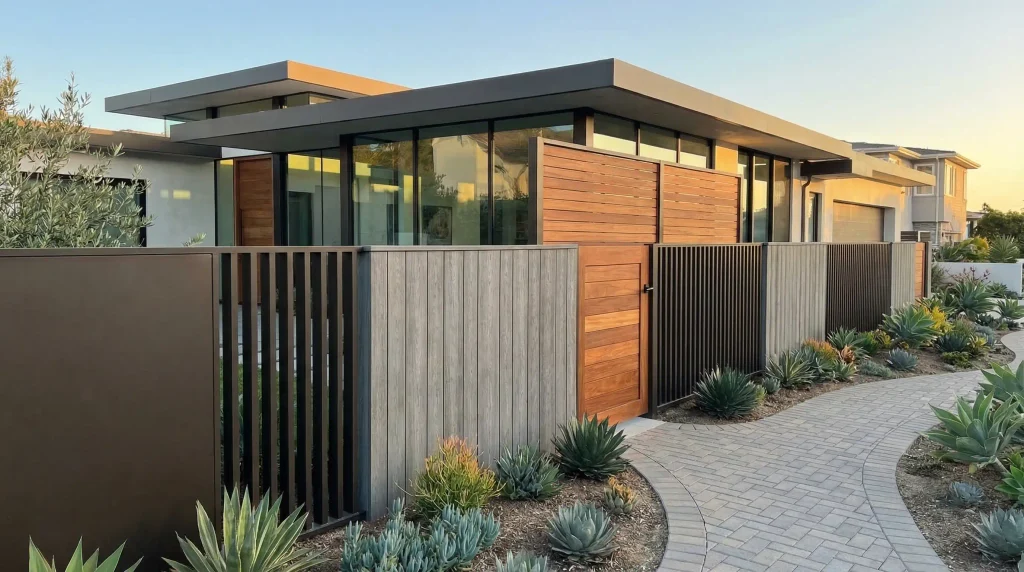
Material specification for exterior fencing comes down to a short list of practical concerns: how it weathers, what it costs to maintain over the building’s life, and whether its appearance holds up without intervention. Aluminum has gained ground against both wood and steel on most of these points.
The maintenance argument
Wood requires periodic refinishing to avoid warping, splitting, and rot — the interval varies by species, finish, and climate, but it’s a recurring line item over a building’s life either way. Steel, left unpainted or with a worn coating, rusts at damage points and welds. Aluminum doesn’t corrode the same way either material does, and a baked-on powder-coat finish generally holds colour and resists chipping better than painted steel or wood over time, though it still benefits from the periodic cleaning most manufacturers specify to keep a warranty in force.
Structural and dimensional considerations
Reinforced panel systems — using an H-profile insert for added rigidity, for example — allow wider sections than a standard residential run, which matters on projects where fewer posts and a cleaner sightline are part of the design intent. PrimeAlux’s Privacy Plus line, built this way, offers 8-foot-wide sections for this reason, where the standard Privacy line runs 6-foot sections. Note that the line’s quoted 220 lb load rating applies to its reinforced 100x20mm slat over a 6-foot span, not to the 8-foot panel as a whole — worth confirming directly with the manufacturer for an 8-foot application.
Where the spec still favours other materials
- Very large industrial or utility perimeters where upfront cost and speed of installation outweigh appearance — chain link remains common there.
- Heritage or traditional-style projects where wood grain and natural weathering are specifically part of the design brief.
- Situations calling for site-welded custom steel work that a modular aluminum system can’t replicate.
Full specs for the standard and reinforced panel lines are published on PrimeAlux’s panel specification sheet
, including the reinforced Privacy Plus system referenced above.
FAQ
Does aluminum fencing rust the way steel does?
No — aluminum doesn’t corrode the way steel does, and a powder-coated finish adds further protection and colour consistency on top of that.
Can aluminum fencing span wider sections than standard residential panels?
Reinforced systems with structural inserts can — PrimeAlux’s Privacy Plus line, for example, offers 8-foot sections versus the standard 6-foot sections on its base Privacy line; its published 220 lb load rating is a slat-level test over a 6-foot span, so confirm span-specific ratings with the manufacturer for a wider section.
Is aluminum fencing ever the wrong choice for a project?
Yes — large industrial perimeters, heritage projects calling for natural wood weathering, and custom welded steel work are all situations where another material may fit the brief better.
Does aluminum fencing need repainting like steel?
Not on the same schedule — a baked-on powder-coat finish typically holds up longer than painted steel before it needs attention, though manufacturers still recommend periodic cleaning to keep it looking right and to maintain warranty coverage.