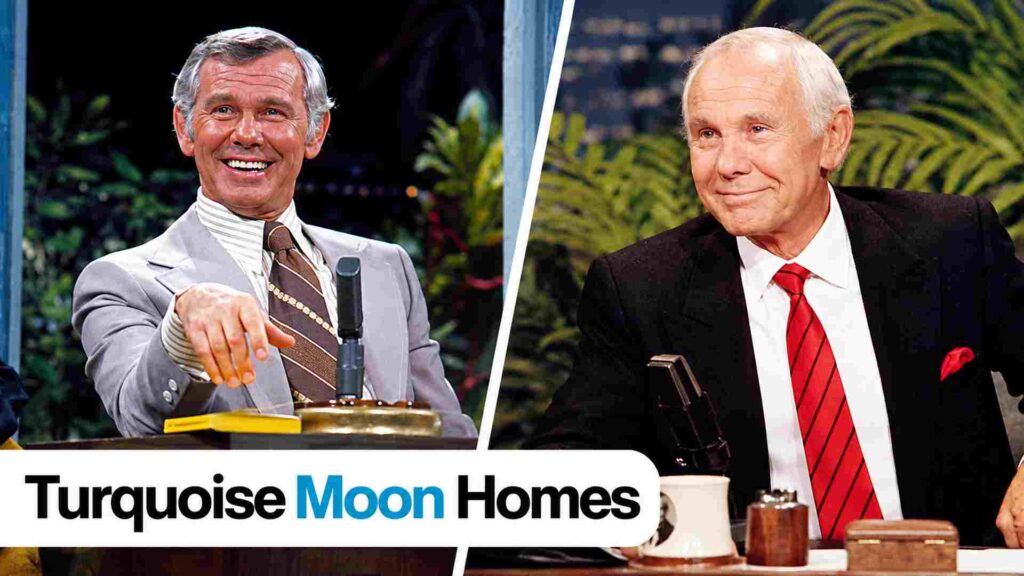
For 30 years, Johnny Carson gave America a reason to stay up late. He sat behind a desk, told jokes about the day, and made his guests feel at home. His show was funny, but it also felt like a daily visit with someone you knew. That bond helped turn a TV host into one of the best-known faces in the country.
His reach went far past one show. Comics dreamed of making him laugh. Stars came to share their new work. Fans watched to see who would walk onstage next. Behind that warm TV style was a man who worked hard at his craft and kept much of his own life out of view.
The story of Johnny Carson starts far from the bright lights of Los Angeles. It begins with a boy who liked magic, found his voice in Nebraska, and learned how to hold a crowd with a well-timed joke.
Who Was Johnny Carson?
Johnny Carson was an American comedian and TV host. He is best known for leading NBC’s The Tonight Show from 1962 to 1992. His full name was John William Carson. He was born on October 23, 1925, in Corning, Iowa, and died on January 23, 2005.
Over three decades, his late-night show became a key part of American pop culture. He made room for short jokes, music, talks with stars, and acts that might not have found such a large crowd on their own. His calm, quick style made the mix feel easy even when the work behind it was hard.
Carson won major awards and left his mark on hosts who came after him. Yet he did not begin life as a TV star. He learned to entertain people in small rooms, long before a studio crowd waited for his first joke of the night.
A Nebraska Childhood and a Love of Magic
Carson was born in Iowa, but he spent much of his youth in Nebraska. His family lived in Norfolk, a town that would stay linked to his name for years. As a boy, he took an interest in magic tricks. The appeal was clear: a trick could catch a room off guard, then bring smiles as people tried to work out what had happened.
Magic also taught him how to stand in front of people. A good trick needs more than fast hands. It needs a steady voice, a plan, and a sense of when to stop talking. Those skills fit comedy as well. A good joke often works because the crowd is led one way, then caught by a turn it did not see coming.
His early life gave him space to try out that mix of timing and showmanship. The young performer who liked small tricks would one day use the same skill on a much bigger stage. He did not need a loud act to make people pay close attention.
Navy Service and College
Carson served in the U.S. Navy during World War II. He later went to the University of Nebraska. There, he studied radio and speech and took a minor in physics. He earned his degree in 1949.
Those facts come from the University of Nebraska’s account of Carson’s life. His college years help explain the path he chose. Radio gave him a place to work with words, sound, and the pace of a live show. Speech helped him think about how to reach an audience. He also kept his interest in the way things worked.
TV was still growing into the force it would become. The skills that worked on radio could travel well to the new screen, but a host had to do more than speak. He also had to work with guests, play to a camera, and handle moments that did not go as planned.
Carson would make that sort of live, loose talk feel natural. It took years of work before he reached a national desk, but his time in radio and his first TV jobs helped him learn what an audience liked.
The Road to The Tonight Show
Carson worked his way through radio and television before NBC gave him its most famous late-night chair. By then, The Tonight Show already had a history. Steve Allen helped shape the show’s mix of jokes and guests. Jack Paar made it a place for frank talk and sharp wit.
When Carson took over from Paar in 1962, he was not the first person to host the program. His task was to make it his own while keeping viewers who loved what came before. He found a balance between fresh comedy and an easy chat.
His jokes were short enough for viewers to follow at the end of a long day. He could move from a quick line about the news to a warm welcome for a guest. He was also willing to let a joke fail. A pause, a look at the crowd, or a small grin could make a weak punch line funny in a new way.
This sense of ease was a large part of the appeal. Viewers could see that he was in charge, yet the show did not feel stiff. Guests had room to talk, and he knew when to move the night along.
Thirty Years Behind the Desk
Carson’s run lasted from 1962 through 1992. That is a long time for any show, but it is even more striking for a daily TV job. People moved, changed jobs, raised families, and grew older while Carson remained part of their late-night routine.
The show’s shape became familiar. There was a monologue, a desk, a guest chair, and time for music or comedy. What kept it alive was not a new set each night. It was the way Carson used that set. His face and voice gave the audience a sense of what sort of evening it would be.
The scale of his work was vast. In a PBS American Masters look at his career, the network notes that the 30-year run covered 4,531 episodes and about 23,000 guests. Those numbers speak to more than staying power. They show how many artists, comics, and public figures passed through the same stage.
The show also became a place where pop culture could meet itself. A film star might sit next to a stand-up comic. A singer could perform after a long talk with an actor. Viewers did not need to know each guest in advance. Carson made each visit part of one evening.
Ed McMahon and the Team That Made the Show Work
A strong host needs people who know when to step in and when to let a moment breathe. Ed McMahon became Carson’s best-known partner on The Tonight Show. His voice, laugh, and steady place near the desk gave the show a sense of fun before the first guest even sat down.
Their work was based on trust and practice. The two men could play off each other without a long setup. McMahon often gave Carson a cue or a laugh. Carson could then turn to the crowd with a quick reply. The result looked casual, which is part of what made it work.
The show also had a band, writers, producers, camera crews, and a large staff. Doc Severinsen became famous to fans as a bandleader with bright clothes and a big sound. Behind every live joke was a team that kept the whole night on track.
It is easy to think of late-night TV as one person talking. Carson’s years show why that view misses part of the story. The host set the tone, but the crew made it possible for the show to reach millions of homes night after night.
A Place Where New Comics Could Break Through
For a stand-up comic, a good set on Carson’s show could be a huge step. It put a new act in front of people across the country. A spot did not promise fame, but it gave comics a chance to show what they could do on a major network.
The moment many comics wanted most came after the jokes. If Carson waved a performer over to the guest chair, it meant the act had made a strong impression. Fans could see that Carson liked what he had heard. For a comic still building a career, that gesture could mean a lot.
The show helped lift the profiles of performers who would shape comedy in later years. David Letterman, Jay Leno, Jerry Seinfeld, and Ellen DeGeneres are among the names tied to its role as a launch pad. New comics saw Carson as both a goal and a model for how to stay calm under pressure.
What made that role special was his clear sense of the craft. He knew the value of a good setup and a clean line. He also knew that humor could come from a strange silence or an honest response. A comic did not have to copy his style to learn from it.
Famous Guests and a Wedding Seen Across America
Carson’s desk hosted more than movie news and jokes. Some nights became TV events in their own right. One of the most unusual came in December 1969, when singer Tiny Tim married Miss Vicki on The Tonight Show. It turned a celebrity wedding into a live event for viewers at home.
The wedding shows just how much power the show held. A talk show could give a singer time to perform, but it could also turn a personal moment into national news. The mix might feel odd now, yet it fit the broad world Carson had built: people watched because they never knew quite what the night would bring.
The guest list over the years ranged across music, film, comedy, and more. Carson had the skill to keep attention on the person in the chair without losing his own place in the show. That made him a useful host for guests with very different ways of talking.
For families who watched from home, these moments became shared memories. One person might recall a song. Another might remember a joke that went wrong in the best way. The daily nature of the show made its big nights stand out even more.
The Private Man Away From the Camera
On screen, Carson could make nearly anyone feel welcome. Away from the studio, he was known for being far more reserved. This gap between the public host and the private man is a key part of his story.
He gave many people a warm, easy hour of TV, but did not give fans the same open view of his own life. There is no need to treat the two sides as a puzzle. A person can be at ease with a crowd and still want peace at home.
His family life included marriages, children, and loss. Those parts of his life mattered as much to him as they do to any person, even if his daily work played out in front of a huge audience. The public knew his jokes better than it knew his home life.
PBS explored that contrast in its film Johnny Carson: King of Late Night. Friends, relatives, and people who worked with him shared memories that showed a fuller picture than the desk alone could give. The film looked at how a master of live TV could also guard his own space.
Honors That Marked His Career
Carson’s work brought him some of the best-known awards in American entertainment. The Television Academy records six Emmy Awards across his career, along with its Governors Award. He was also honored with a Peabody Award.
The honors did not stop there. He received the Presidential Medal of Freedom in 1992 and a Kennedy Center Honor in 1993. The Television Academy added him to its Hall of Fame in 1987.
These awards mark the reach of his work, but they tell only part of the tale. The most lasting measure may be how many people learned from his tone and timing. His show taught the next wave of hosts what a late-night desk could become.
The awards also show that his work was more than a long run of jokes. Across 30 years, he helped set the style for an art form that is still a major part of TV. Even hosts with very different voices work in a space he helped define.
His Final Tonight Show In 1992
Carson ended his time on The Tonight Show in May 1992. After so many years, the end felt like more than a change of staff at NBC. It was the close of a shared habit that had lasted for a full generation.
His final stretch on the show drew a vast audience. Fans wanted one more look at the host they had watched for so long. It was a rare TV farewell in which the person leaving had been part of the daily rhythm of millions of lives.
He did not move right into another daily talk show. That choice made his years at the desk feel like a finished body of work. Future hosts could add new ideas, but Carson’s era had a clear end.
The last show remains a marker in television history because it brought together a simple fact and a strong feeling. A long career had come to its close. The people watching knew their nights would not feel quite the same.
The Legacy He Left Behind
Carson died on January 23, 2005. He was 79. His death brought new attention to the old clips, the guests he welcomed, and the comics who had learned from him. It also brought back memories of a time when a single late-night host could feel like a friend to much of the nation.
His ties to Nebraska stayed strong after his death. Gifts from the Johnny Carson Foundation helped the University of Nebraska build the Johnny Carson Center for Emerging Media Arts. The center opened in 2019, giving new artists a place to study work that blends art, media, and new tools.
That is a fitting part of his legacy. He began with magic, radio, and a love of making people react. The center looks toward new ways to tell stories. The tools have changed, but the core idea is much the same: learn your craft, know your audience, and make the moment count.
His influence still reaches into living rooms through late-night hosts, video clips, and fans who recall a favorite guest. He proved that a good host does not have to fill every second with noise. At times, the best move is to listen, smile, and let someone else have the floor.
Why Johnny Carson Still Matters
It would be easy to call Carson the king of late night and leave the story there. His real gift was more down to earth. He made a daily show feel human. He let people be funny, strange, shy, or full of stories, and he found a way to keep the night moving.
Young comics saw a chance to reach the country. Guests found a host who knew how to make them look good. Fans found a calm place to end the day. For many years, those small things added up to something large.
If you enjoy the family stories behind classic TV, read our article about Tony Hinchcliffe and his rise in stand-up comedy at Turquoise Moon Homes.

Nike Carkarel
Nike Carkarel writes about home decor, interior design, and practical ways to make living spaces more beautiful and comfortable. At Turquoise Moon Homes, Nike shares ideas for decorating rooms, choosing furniture, improving home layouts, and making everyday spaces work better. With an interest in thoughtful design and simple home improvements, Nike helps readers find inspiration for homes that feel welcoming, stylish, and easy to live in.