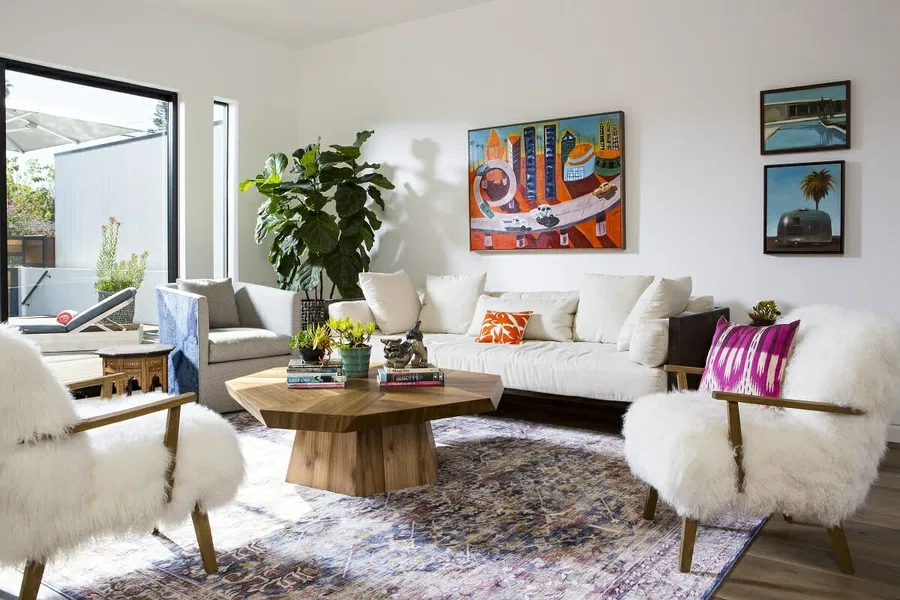
Good living room accent chair placement gives someone a comfortable seat without blocking the path through the room. A chair usually works best when it faces part of the conversation area, has room to move around it, and offers a useful surface or light nearby. The right position depends on the sofa, doors, windows, and how the family actually uses the space.
A beautiful chair can still be the wrong choice if everyone has to squeeze past its arms on the way to the kitchen. Before buying another piece, try arranging the room around walking routes and real daily habits rather than around a showroom photograph.
Here are practical ways to place one chair or a pair, choose the right scale, and make a living room feel welcoming without filling every empty corner.
Begin With the Route People Walk Every Day
Stand in the doorway and imagine carrying a laundry basket, a tray of drinks, or a sleeping child across the room. That route needs more breathing room than a little gap between two decorative pieces. Mark the main path on a rough floor sketch before deciding where a chair should sit.
Do not place the chair where its back or legs interrupt the most direct path to another room. A swivel chair needs space for rotation, while a recliner needs clearance when extended. Measure the chair in its working position, not just the footprint shown in the catalog.
Try a temporary outline with painter’s tape or flattened cardboard. Leave it on the floor for a day and notice where people step around it. This simple test can reveal a problem that is hard to see when you are focused on the chair’s color or shape.
Make the Chair Part of the Conversation
A chair facing directly away from the sofa often feels like separate furniture rather than another place to sit together. Turn it slightly toward the sofa or coffee table so a person can join a conversation without twisting their neck. The angle does not have to be perfectly symmetrical to feel intentional.
Living room accent chair placement becomes easier when you identify the main activity. For casual conversation, bring seating close enough for relaxed voices. For movie nights, a chair can sit a little to the side of the television without forcing someone to look over a shoulder. For reading, daylight and a lamp may matter more than the screen.
Pottery Barn’s living room seating guide encourages choosing furniture around the way a room is used. That is a useful starting point: a chair that serves an actual habit will feel more natural than one placed only to fill a blank spot.
Living Room Accent Chair Placement Across From a Sofa
In a rectangular room, a single accent chair often fits near the open end of the sofa rather than directly opposite its center. This creates an inviting conversation triangle with the coffee table. It also avoids making the room look like a formal waiting area when the rest of the home is casual.
Keep enough space for knees, feet, and the edge of the table. A chair with a deep seat may need to sit farther back than a compact upright armchair. Sit in it before finalizing the arrangement. If reaching the table feels awkward or the route past the chair is tight, adjust the position.
An accent chair can balance a sectional without trying to match its size. Choose a lighter visual frame if the sofa is bulky. Open legs, a modest back, or a narrow arm can help the room feel less crowded, even when the chair provides the same useful seat.
Living Room Accent Chair Placement for Two Seats
Two chairs can form a welcoming conversation area across from a sofa, especially when the room is wide enough for a small table between them. The pair does not have to be identical. Similar seat heights or shared colors can make different designs feel related without turning the space into a matched furniture set.
If the chairs sit near a window, protect the view and the way the window opens. Avoid tall backs that block much of the daylight in a small room. A low lounge chair may work better in front of a broad window, while a taller reading chair can fit in a side corner.
Measure the space between the chairs and the path behind them. A narrow gap may look fine in a photograph but feel awkward when people stand up. Test both chairs with someone seated. Their elbows, feet, and the room’s natural traffic pattern matter more than exact symmetry.
Create a Reading Corner That Actually Gets Used
A chair near a window can become a favorite spot when it has a lamp for evenings and a surface for a book or cup. Position the lamp so light falls onto the page rather than shining into the reader’s eyes. A small table should be reachable without leaning far forward.
Choose the chair for the task. A sculptural accent chair with a hard seat may be lovely for a brief chat but uncomfortable for an hour with a novel. Check back support, seat depth, and arm height. If the room is shared by adults of different sizes, let the most frequent user test it.
Crate & Barrel’s accent-chair styling guidance highlights the value of placing chairs near useful features and layering accessories. The important detail is restraint: a reading corner needs light and a place to set something down, not a tower of decorative objects.
Balance Color and Visual Weight
A dark, wide chair can look heavier than a light chair with exposed legs, even when their measurements are similar. If the sofa is already large and deep, a slimmer accent chair can make the arrangement feel less crowded. In a spacious room, a substantial chair may help anchor an otherwise empty corner.
Match one detail rather than every detail. A chair might echo the sofa’s wood tone, a color from the rug, or the texture of a nearby cushion. Exact fabric matches can make the room feel flat, while too many unrelated bold pieces compete for attention.
Look at the chair from the doorway and from the seat where people usually sit. Does it hide a favorite lamp, crowd the coffee table, or leave one side of the room visually empty? Small shifts of a few inches can change the balance without buying another piece.
Handle a Fireplace, TV, and Door in the Same Room
Many living rooms have more than one focal point. A fireplace may anchor one wall, the television another, and the main door a third. Rather than forcing every chair to face everything, decide which activity takes priority. A slight angle can connect a chair to the sofa while still allowing a view of the screen.
Respect safe clearances around fireplaces and heaters according to the appliance’s instructions. Do not place upholstered furniture so close that heat or sparks could damage it. A chair that looks perfectly centered beside a hearth may need to move farther away for safe everyday use.
If a door swings into the seating area, mark its full arc on the floor. Leave space for the door to open without hitting a chair leg. A small chair placed just beyond that arc often works better than a larger chair wedged between the door and sofa.
Solve the Small Living Room Problem First
In a small room, one flexible chair can do more than two fixed ones. A compact swivel chair may serve the conversation area and the window, but it needs enough room to turn. A light occasional chair can be moved for guests. A storage ottoman may offer a spare perch without taking the place of a comfortable everyday seat.
Our guide to small living room ideas explores ways to protect floor space. The same rule applies here: keep the useful center of the room open and avoid adding furniture simply because there is a patch of bare wall.
If the sofa is oversized, adding a chair may make the room worse. Try moving the sofa, reducing the coffee table footprint, or removing an unused side table first. A more efficient arrangement can create space for a chair without changing the room’s dimensions.
Test Your Living Room Accent Chair Placement
Take a photo of the room from each entrance, then move the chair into two or three realistic positions. Sit in every seat, reach for the table, watch the television, and walk to the next room. This is a better test than deciding from one overhead sketch.
Give the new arrangement a weekend before purchasing more accessories. Notice whether people choose the chair or continue to sit elsewhere. If nobody uses it, the location may be too isolated, too dark, or uncomfortable. That feedback is more useful than a perfect-looking furniture grid.
Once the layout works, use a rug or small table to connect the chair to the sofa. Our sectional sofa rug size guide explains how a rug can make seating feel like one group. The chair should belong to the arrangement without blocking the path through it.
Final Thoughts
Living room accent chair placement is less about following one perfect diagram and more about making an extra seat feel welcome. A chair earns its space when people can reach it easily, use it comfortably, and still move through the room without detours.
Choose the place that fits your everyday routine first. Then let color, fabric, and a thoughtful lamp make it feel like home.
