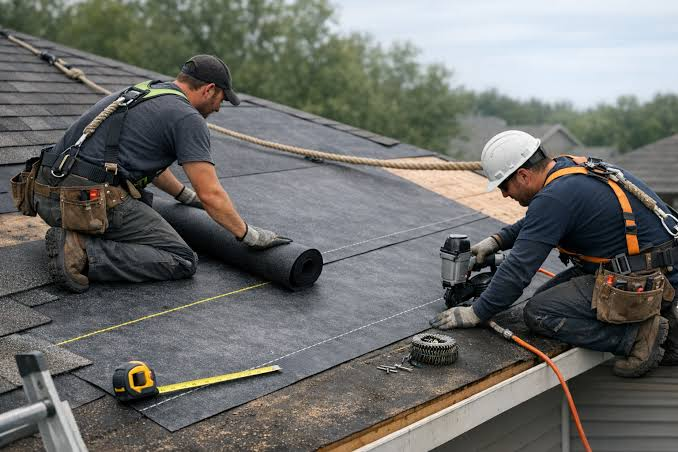
Roof underlayment types usually fall into three practical groups: asphalt-saturated felt, synthetic sheet underlayment, and self-adhered membrane often called peel-and-stick or ice-and-water barrier. Each sits beneath the finished roofing, but the materials behave differently when exposed to rain, foot traffic, heat, and vulnerable roof details.
If you are replacing a roof, the estimate may list “felt,” “synthetic,” or a brand name without explaining what you are buying. The shingle color is easy to picture; the layer you will never see again is harder to judge. Yet the choice affects installation, temporary weather protection, and how water is managed around trouble spots.
Here is a homeowner-friendly comparison of roof underlayment types, including where each belongs, which upgrades may be worth paying for, and the questions that keep a roofing quote from becoming a guessing game.
What roof underlayment actually does
Underlayment is a secondary layer over the roof decking and beneath shingles or another roof covering. It helps shed incidental water that gets beneath the outer roof surface. It is not intended to make damaged or missing shingles irrelevant, and a mechanically fastened sheet is not the same as a waterproof, sealed membrane.
Picture a windy storm driving rain beneath a shingle edge. The outer roof is still the first defense, but properly lapped underlayment helps guide that water toward the eave. A good installation also depends on flashing, fasteners, roof slope, and how the material meets vents, walls and valleys.
That is why the answer to “Which underlayment is best?” changes with climate and roof shape. A simple, steep gable roof in a mild area may need a different combination from a low-slope roof with several valleys in a snowy region.
Traditional asphalt-saturated felt
Roofing felt is a familiar paper-like sheet saturated with asphalt. Common labels include No. 15 and No. 30, though those historic names are not reliable promises of the actual weight of every modern roll. The exact standard and manufacturer specifications matter more than the nickname.
Felt can be a reasonable code-compliant choice when properly selected and installed. Its main attraction is often material cost and familiarity. A crew that works with it regularly knows how to lap courses, avoid wrinkles, and cover the roof promptly.
The tradeoff is sensitivity to jobsite conditions. Some felts can absorb moisture, wrinkle, tear near fasteners, or become more awkward to handle in rain. If a roof is likely to sit uncovered while a crew waits for materials, exposure limits deserve special attention.
Synthetic sheet underlayment
Synthetic underlayment is generally made from engineered polymer sheets. Many products are lighter than felt, come in larger rolls, and offer greater resistance to tearing. Some have textured walking surfaces designed to improve traction during installation, though no roofing surface is safe to walk without proper professional fall protection.
Not every synthetic sheet has the same properties. Thickness, vapor permeability, UV exposure allowance, fastener requirements, and approved roof coverings can vary widely. A label that says “premium synthetic” is not enough to establish suitability for your roof.
GAF’s overview of roof underlayment choices describes how its synthetic products differ from traditional felt. Treat those descriptions as product guidance, not as proof that every synthetic membrane performs identically.
Self-adhered peel-and-stick membranes
Peel-and-stick underlayment bonds to the roof deck rather than relying only on a field of mechanical fasteners. Many products use modified asphalt and are designed to seal around properly driven nails. They are often specified for eaves in ice-dam regions, valleys, and other areas where water may back up or linger.
This category is different from a standard synthetic sheet. A roof can use synthetic underlayment over broad open areas and self-adhered membrane at vulnerable details. It is usually not a choice between one or the other for every square foot.
Owens Corning’s WeatherLock Flex barrier guidance lists eaves, valleys and roof penetrations among the vulnerable locations where its self-adhered product is intended to help resist water infiltration. Installation temperature, deck preparation and product compatibility remain important.
Felt versus synthetic: what you notice on an estimate
On a straightforward reroof, the material line item for felt may be lower. But installed price also reflects labor, waste, roll coverage, fasteners and crew preference. A cheaper roll does not automatically produce the cheapest completed job, and a more expensive synthetic does not rescue careless installation.
Ask whether the proposed product meets the code and shingle manufacturer’s requirements. Request the brand and model, not just the generic material name. Two synthetic products with similar colors may have very different published exposure and fastening limits.
Also ask how quickly the crew plans to install the shingles after laying underlayment. Temporary UV exposure ratings are maximums under stated conditions, not invitations to leave a house covered with underlayment for months. Weather forecasts and the manufacturer’s instructions should govern the schedule.
Where peel-and-stick is worth discussing
Eaves in snowy climates are a common starting point because melting snow can refreeze near the cold roof edge. Water can back up beneath shingles when an ice dam forms. A self-adhered membrane helps create a second defense, but it does not fix the attic heat loss and ventilation conditions that contribute to ice dams.
Valleys deserve attention because two roof planes concentrate runoff. Skylights, chimneys and roof-to-wall transitions also involve complex flashing details. In these places, the best result comes from compatible layers installed in the correct order, not simply from covering every joint with sticky material.
Our guide to ice dam prevention explains why roof-edge membrane is only one part of winter protection and why air sealing matters before the next cold season.
Does more underlayment always mean a better roof?
No. Multiple layers can be required for particular low slopes, but adding layers without following a tested roof assembly can create fastening, drainage or warranty problems. A contractor should explain which assembly applies to the actual roof pitch and shingle model.
Whole-deck self-adhered membrane may be appropriate in some systems, yet it can change how a roof deck dries. Ventilation and moisture design deserve special attention when a low-permeance layer covers large areas. The answer depends on the climate, attic configuration and product requirements.
For this reason, roof underlayment types should be evaluated as components of a complete roof. The deck condition, ventilation path, flashing, shingle compatibility and local code all influence the decision. Buying the strongest-looking roll alone is not a design plan.
How roof slope changes the installation
A steep roof sheds water faster than a low-slope one. That does not mean steep roofs are immune to wind-driven rain, but it changes the likelihood that water will move slowly or back up at laps. Shingle manufacturers often specify special underlayment arrangements for pitches below 4:12.
Ask the roofer to identify each roof plane’s pitch, especially on porches and additions. A house can have a steep main roof and a much flatter side roof. Applying the same sheet and lap pattern everywhere may not meet the instructions for both areas.
Do not assume that a peel-and-stick membrane makes asphalt shingles acceptable on a slope below their minimum permitted pitch. The roof covering itself must be suitable for that slope. When a section is too flat, a different roofing system may be needed.
What about roof decking that looks damaged?
Underlayment must sit on a suitable deck. Soft, rotten, delaminated or poorly fastened decking can undermine the entire roof system. Covering a weak deck with a new sheet makes the damage less visible, not less serious.
Before the work begins, ask how the contractor will handle hidden deck repairs and how replacement wood will be priced. A clear allowance or unit price prevents surprises after tear-off. Photographs of the exposed deck can also help you understand why a change order was necessary.
Deck seams, protruding fasteners and debris can interfere with the way some membranes lie flat or adhere. Surface preparation is especially important with self-adhered products, which rely on contact with the substrate rather than just overlap.
How underlayment should be installed at the edges
The order of drip edge, underlayment and starter shingles can differ between eaves and rakes. The crew should follow the specific manufacturer’s detail and local code. Incorrect layering may route water beneath the metal instead of over it.
Fastener placement also matters. Mechanical sheets commonly require approved cap fasteners or other specified hardware and overlap distances. Random staples or widely spaced nails can compromise temporary weather resistance and fail to meet a product’s instructions.
Self-adhered material needs clean, suitable surfaces and the correct application temperature. Wrinkles, fishmouths and poorly sealed laps can create channels for water. Ask to see the underlayment stage before the shingles cover it, particularly on a complex roof.
What a complete roofing quote should say
A useful quote identifies the underlayment manufacturer, product name, roof areas covered, number of layers if relevant, and the specific locations receiving self-adhered membrane. It should also describe ice-barrier coverage at eaves, valley details and flashing replacement.
Compare two estimates by scope, not just by price. One may include self-adhered membrane in valleys while the other assumes a basic sheet everywhere. One may allow for deck replacement while another excludes it. Without those details, the bids are not truly comparable.
Ask for the installation document and a brief explanation of how the selected roof underlayment types match your roof pitch, climate and shingle warranty conditions. A contractor who can answer plainly is easier to work with if questions arise during the job.
Three practical homeowner scenarios
A simple roof in a mild climate: a properly specified felt or synthetic sheet may both be viable. Compare total installed price, tear resistance and the roofer’s installation plan rather than assuming the most expensive product is mandatory.
A snow-prone home with recurring eave ice: pay special attention to code-required ice-barrier coverage, attic air leaks and insulation. An upgraded membrane can help limit damage from backed-up water, but the underlying heat and moisture problem still needs attention.
A roof with many valleys and penetrations: detail work often matters more than the broad field material. Ask for drawings or photographs showing where the peel-and-stick barrier, metal flashing and main underlayment meet.
Common mistakes to avoid
Do not choose solely by the words “waterproof” or “premium.” Some products resist incidental water but are not intended as a permanent exposed roof. Others require a compatible roof covering within a stated time. Marketing language should never replace the technical sheet.
Do not let a crew cover an obviously wet or deteriorated deck simply to beat a storm. The correct response depends on the condition, but hidden moisture can lead to bigger repairs later. Ask how materials will be protected if work pauses unexpectedly.
Finally, avoid comparing roof underlayment types without checking what the contractor is actually installing. A product name, location map and manufacturer instructions are far more useful than a generic line that says “new paper.”
Choosing the right combination
For most homeowners, the strongest approach is not one magic sheet. It is a compatible system: sound decking, correctly chosen field underlayment, targeted self-adhered protection where needed, well-detailed flashing and shingles suited to the slope.
Ask the contractor to explain the proposed layers in the order water encounters them. If that explanation makes sense, matches the product documents and addresses the vulnerable parts of your house, you are in a much better position to compare the cost and value.
Is synthetic roof underlayment always better than felt?
It often offers handling and tear-resistance advantages, but suitability depends on the specific product, roofing system and installation. A correctly installed approved felt may still be appropriate.
Is ice-and-water shield the same as synthetic underlayment?
No. Ice-and-water shield is generally a self-adhered barrier for water-prone details, while ordinary synthetic sheet underlayment is mechanically attached across larger areas.
Can underlayment stop a roof leak by itself?
It is a secondary defense, not a substitute for sound shingles and flashing. Persistent leaks need the outer roof system inspected and repaired.
