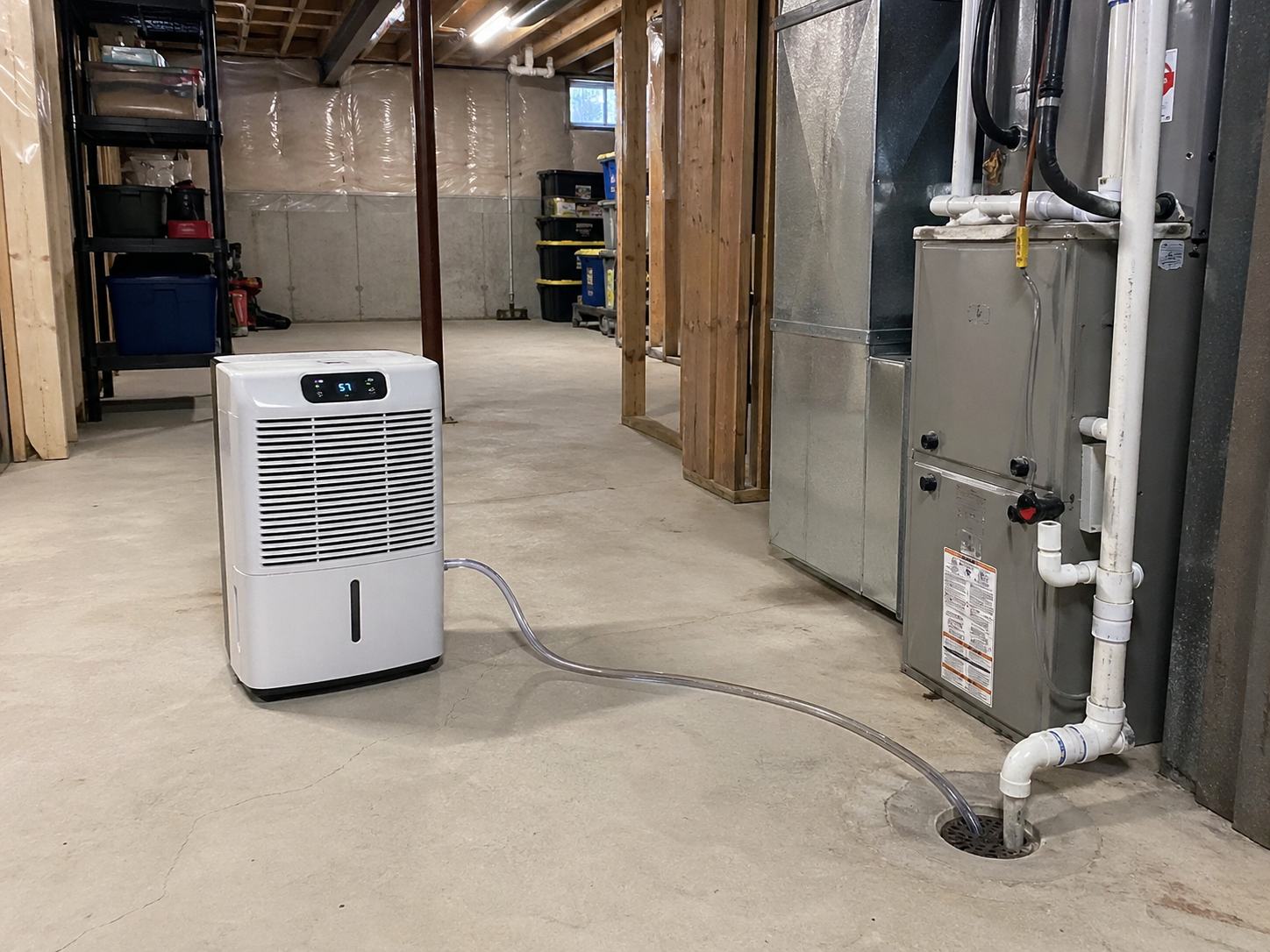
Basement dehumidifier size depends on two things: how much floor area the machine serves and how much moisture is in that space. A damp 600-square-foot basement may need a stronger unit than a larger, fairly dry room. The number printed on the box—20, 35 or 50 pints per day—describes moisture removal under a standardized test, not how many gallons the collection bucket holds.
That distinction matters when the basement smells musty after rain or the windows sweat in summer. Buying a machine solely because its packaging claims a large square-foot coverage can leave it running all day without bringing humidity down. A better choice starts with a few days of actual humidity readings and a look for water entering the space.
Here is how to size a portable unit, choose drainage and placement, and tell when a dehumidifier is helping with ordinary moisture versus masking a problem that needs repair.
Start with humidity, not the square-foot claim
Measure relative humidity with a small digital hygrometer. Take readings near the center of the basement and in the dampest corner, ideally over several days and after rain. The readings matter more than whether the air simply feels clammy, because cool basement air can feel damp even when conditions change only a little.
The U.S. Environmental Protection Agency recommends keeping indoor relative humidity below 60 percent and ideally in the 30 to 50 percent range when practical. That guidance is useful for choosing a setpoint, but it does not mean every basement must be forced to exactly 30 percent.
Use a second reading to check the dehumidifier’s built-in sensor after it has been running. Sensors near the machine can see a different pocket of air from the far corner of the room. A separate meter helps reveal whether the whole space is improving.
What the pint rating actually means
A 35-pint dehumidifier is rated to remove up to 35 pints of moisture from the air in a 24-hour period under the relevant test conditions. That is a performance rating, not the size of its water tank. Many machines collect only a fraction of that amount before the bucket needs emptying.
The testing method changed years ago, so an older machine labeled 50 or 70 pints may not be directly comparable with a new model’s number. Compare current-rated units using the same testing standard rather than assuming the older, larger printed figure always represents greater capacity.
Basement dehumidifier size should also account for temperature. Portable compressor units generally remove less moisture as air becomes colder. If your basement stays chilly, check the operating-temperature range and defrost features instead of relying on a rating measured under warmer conditions.
ENERGY STAR’s sizing ranges for damp spaces
The ENERGY STAR dehumidifier guide groups spaces by both size and dampness. For an area under 2,000 square feet, its ranges are roughly 20–30 pints/day for slightly to moderately damp conditions, 25–40 for very damp conditions, and 30–50 for wet conditions.
For areas over 2,000 square feet, the same guide starts around 30, 40 and 50 or more pints per day respectively. These are broad selection ranges, not a promise that any one machine will solve an active foundation leak. The chart is most useful after you have identified which moisture condition resembles your basement.
If the room has occasional mustiness but no wet surfaces, start toward the lower part of the relevant range. If walls regularly show condensation, laundry adds moisture, or the space is near the upper end of its area band, compare the stronger models.
Example: a 500-square-foot basement that smells musty
Suppose a finished basement measures 20 by 25 feet. It smells stale on humid afternoons, but the walls and floor stay dry. The hygrometer reads around 60 to 65 percent after several warm days. That resembles a slightly to moderately damp space rather than a basement with visible seepage.
A current-rated 20- to 30-pint machine may be a reasonable starting point under the ENERGY STAR chart. A unit near the upper end can offer more capacity during humid spells, though it may cost more and take up extra floor space. Choose one with an adjustable humidistat rather than a simple always-on switch.
Run it with basement windows closed during humid weather. Then watch how the humidity changes over several days. If the machine barely moves the reading, check the drain, airflow, temperature and hidden moisture sources before assuming the only solution is a bigger unit.
Example: an 800-square-foot basement with damp spots
Now imagine a basement that measures 20 by 40 feet. The air smells musty most days, and there are damp marks on the foundation wall after heavy rain. A 25- to 40-pint range may suit the “very damp” category, but the damp wall changes the priority.
A dehumidifier can reduce water vapor already in the air; it cannot stop water moving through a crack, clogged exterior drain or poor grading. Investigate the water path before finishing the room or putting boxes against the wall. A larger unit may lower humidity while the underlying moisture continues to damage materials.
Document where the spots appear, whether they dry between storms, and whether the downspouts discharge close to the foundation. That evidence helps a qualified contractor diagnose the water source rather than recommending an appliance as a substitute for drainage repair.
When a 50-pint unit makes sense
A 50-pint portable unit is often considered for wet basements, larger rooms or spaces with substantial moisture loads. It is not automatically the best purchase for every home. The machine may be bulkier, noisier and more expensive, and its fan must be able to circulate air through the space it serves.
In a basement with several closed rooms, a single large unit placed in a hallway may not control humidity behind every door. You may need better air circulation or separate zones. Check the manufacturer’s recommendations for clearance and airflow before choosing a location.
ENERGY STAR generally advises erring larger rather than smaller when you are between suitable capacities. Still, basement dehumidifier size should be matched to a realistic moisture problem, not a sales claim that a huge unit can dry an entire house through closed doors.
Choose continuous drainage if emptying the bucket is a chore
A bucket model works when someone is home to empty it. In a very damp basement, the bucket may fill quickly and shut the unit off. Continuous drainage through a hose can keep the machine operating without daily attention, provided there is a suitable drain below the outlet.
A gravity hose needs a consistent downhill path. Avoid loops that trap water or a hose end submerged in a drain. If the nearest suitable drain is higher than the machine, a model with an integrated condensate pump may be useful. Follow the manufacturer’s discharge and backflow instructions.
Test the drainage arrangement before leaving the machine unattended. Confirm that water flows where intended and that the hose cannot be kicked loose. A dehumidifier meant to prevent moisture should not become the source of a wet floor.
Placement changes how well the unit works
Keep the intake and exhaust clear according to the manual. Tucking the unit tightly behind a couch or under a shelf may block airflow and cause it to cycle inefficiently. A central location can work in an open basement, but the dampest zone may need extra circulation.
Do not place a portable unit where standing water is present or where its cord can be damaged. Use a properly grounded outlet as directed by the manufacturer; avoid extension cords and improvised power strips. A damp basement deserves extra care around electrical equipment.
Think about sound as well. A unit next to a home theater or guest bed may be annoying even if it is technically effective. If noise matters, compare published sound ratings and consider whether a nearby utility area offers better placement without blocking airflow.
Energy use: what to compare beyond capacity
Two machines with the same pint rating may use different amounts of electricity to remove the same quantity of water. Look for the ENERGY STAR label and the published efficiency information rather than focusing only on purchase price.
A machine that runs continuously because it is undersized can be frustrating. A properly selected unit should eventually reach its setpoint and cycle as needed, assuming the basement is not receiving a constant uncontrolled source of moisture. Extremely low settings can also keep a machine running longer than necessary.
Clean the filter on the schedule in the manual. A clogged filter reduces airflow and can hurt performance. Check the bucket, hose and drain fitting as part of the same routine so a small maintenance issue does not become an all-week humidity problem.
Do not confuse humid air with a water leak
Condensation often appears on cool pipes, ducts or concrete surfaces during humid weather. Seepage is more likely when water stains track from cracks, joints or wall-to-floor connections after rain. Plumbing leaks can create a different pattern, sometimes unrelated to outdoor weather.
The EPA’s guidance on indoor humidity and mold explains why controlling moisture is essential. But if water is actively entering the basement, fix that source first. A dehumidifier cannot make saturated insulation, soaked drywall or wet stored boxes safe to ignore.
For homes with damp lower levels, our guide to a crawl-space vapor barrier shows how ground moisture can move into a building and why controlling the source matters more than treating the air alone.
How to test whether your new dehumidifier is enough
Record the starting humidity, room temperature and weather. Set a reasonable target such as 50 percent, then run the unit according to its manual with windows closed. Check readings at similar times each day for several days, not just the first hour.
Look for a downward trend and fewer musty odors. Empty or inspect the bucket so you know the machine is actually removing water. If the humidity remains high, verify the filter, room temperature, door arrangement and drain function before returning the unit.
When humidity rises immediately after rain despite long operating hours, investigate drainage, foundation cracks and plumbing. That pattern may call for a building repair rather than another portable appliance.
When to consider a whole-house or dedicated basement system
A large, open basement with high moisture load may be better served by a dedicated dehumidification system. These can provide more controlled drainage and integration with ventilation, but installation cost and service requirements are higher.
Ask an HVAC professional whether the existing heating and cooling system actually serves the basement. A return grille or supply vent alone does not prove that summer moisture is being managed. A professional can consider airflow, ducting and condensation risks.
Do not connect a portable unit to ductwork unless it is specifically designed for that use. The safest solution is one engineered for the actual space and installed in accordance with its instructions.
A practical buying checklist
Measure the area, log humidity, identify damp spots, and note the room temperature. Decide whether gravity drainage is possible and where the unit can stand with adequate clearance. Compare current pint ratings, energy efficiency, noise and maintenance access.
Finally, budget for fixing the moisture source. The right basement dehumidifier size makes the air more comfortable and helps control excess humidity. It is most effective when the building is already keeping liquid water outside where it belongs.
Is a 50-pint dehumidifier too big for a small basement?
Not necessarily, but it may cost more and take more space than needed. Match the capacity to the measured moisture load and the current ENERGY STAR sizing ranges.
What humidity should a basement dehumidifier be set to?
About 50 percent is a practical starting point for many homes. The EPA recommends staying below 60 percent and ideally around 30 to 50 percent when feasible.
Will a dehumidifier fix water seeping through basement walls?
No. It removes water vapor from the air, not liquid water entering through cracks or drainage problems. Repair the source of seepage.
