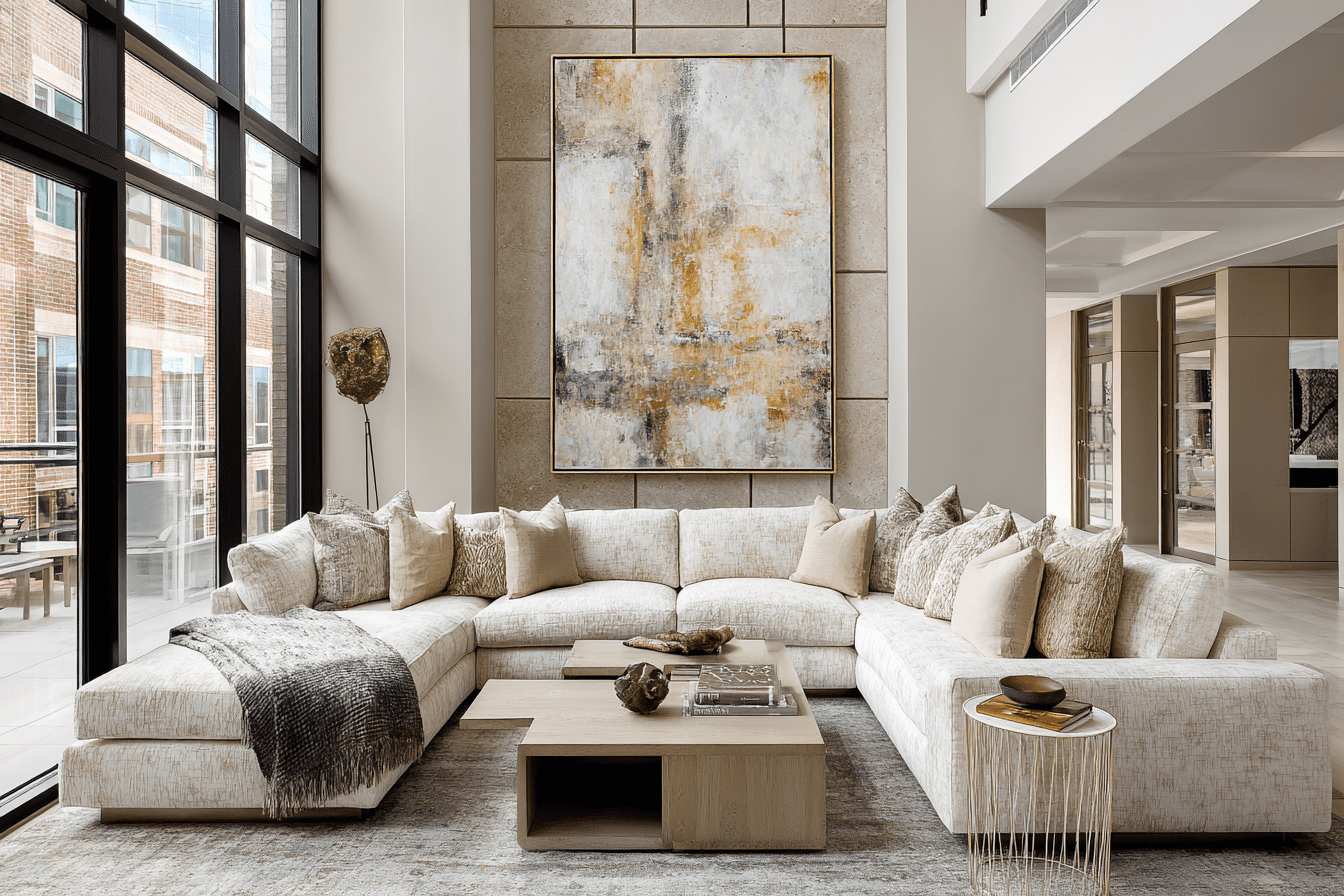
Living room wall art height works best when you measure from what people actually see: the center of the artwork on an open wall, or the gap between the frame and the furniture below it. A common starting point for a single piece on an empty wall is a center around 57 to 60 inches from the floor. Above a sofa, the relationship to the sofa usually matters more than that general eye-level rule.
This is why a beautiful print can look strangely disconnected after you hang it. The frame may be perfectly level, yet the bottom sits a foot and a half above the couch. Or a gallery wall looks balanced on the floor but crowds a lamp once it is mounted.
Before making holes, work out the frame’s real size, the sofa’s position, the hanging hardware, and how the room is used. A little measuring saves a surprising amount of patching.
Start with the sofa, not the ceiling
For artwork above a sofa, try a bottom-edge gap of roughly 6 to 10 inches above the sofa back as an initial design range. This is a flexible decorating guideline, not a building standard. A very tall sofa, oversized artwork, or a person who regularly leans back against the wall may need more clearance.
Stand across the room and look at the sofa and artwork as one arrangement. If the picture appears to float on a separate part of the wall, bring it visually closer to the furniture. If the frame feels crowded or might be bumped by someone’s head, move it higher or choose a different piece.
Living room wall art height is also affected by the shape of the furniture. A low modern sectional often looks good with a broader, lower arrangement. A tall-backed traditional sofa may need a narrower piece or a little more breathing room.
Use the 57-inch center rule on an open wall
When no furniture anchors the artwork, an eye-level center around 57 to 60 inches from the finished floor is a useful starting point. Measure to the vertical midpoint of the art, not the top of the frame or the nail. The number is a convention, not a universal answer for every person’s height.
Consider a 24-inch-tall frame. If its center is 58 inches from the floor, the frame extends from about 46 to 70 inches, before accounting for any hanging hardware. That often looks comfortable in a hallway or open living room wall.
Do not force the rule onto a wall where the artwork is meant to relate to a console, sofa or fireplace. In those situations, the visual grouping is usually more important than a fixed measurement from the floor.
How wide should art be over a couch?
Height is only half the story. A tiny picture centered above a long sofa can look lost even when hung at the right level. As a starting point, many decorators choose art or a grouped arrangement that spans about two-thirds to three-quarters of the sofa width.
For a 90-inch sofa, that suggests a grouping around 60 to 68 inches wide. It might be one large horizontal canvas, two matching frames with a small gap, or a carefully planned gallery arrangement. These are visual proportions, not hard limits.
If the sofa is tucked into a corner, center the artwork over the sofa rather than automatically centering it on the entire wall. The wall’s midpoint and the seating area’s midpoint may be different, and the eye usually follows the furniture.
Find the real nail height with one simple calculation
Suppose a framed print is 30 inches tall, and you want its center 58 inches from the floor. Half the frame height is 15 inches, so the top will sit at 73 inches. Now measure how far below the frame’s top the actual hanging point sits when the wire is pulled taut or the D-rings are engaged.
If the hanging point is 3 inches below the top, the wall hook belongs at about 70 inches. Mark that point with pencil or low-tack tape. A common mistake is to put the nail at the desired frame top and discover that the wire makes the artwork hang several inches too low.
For a pair of frames, repeat the measurement for each one. Hardware positions can differ even when frames look identical. Level the final arrangement after both pieces are on the wall rather than assuming equal nail heights guarantee equal tops.
Make a paper template before drilling
Cut kraft paper or newspaper to the outside dimensions of the frame and tape it to the wall. Mark the intended center and the proposed bottom gap. This lets you test living room wall art height while sitting on the sofa, standing at the doorway, and walking through the room.
Leave the paper up through a normal evening. Daylight can make a wall feel open, while lamps and shadows change the balance at night. If the template feels too small or too high, adjust it before committing to a hole.
For a gallery wall, lay all templates on the floor first, then transfer them to the wall. Keep the spacing intentional. A repeated gap of two or three inches often looks calmer than a collection of unrelated distances, but irregular groupings can work when they are carefully balanced.
One large piece or several smaller frames?
A single large artwork creates a clear focal point and is usually easiest to position. It suits rooms where the sofa is already surrounded by busy shelves, patterned curtains or a strong rug. The tradeoff is that a large frame may need heavier-duty mounting hardware.
Two or three frames can fill a wide wall without the cost or handling challenge of one oversized piece. Match their top or center lines so they read as a deliberate set. A pair often works well above a symmetrical sofa, while three smaller pieces can echo a long sectional.
A gallery wall adds personality but takes more planning. Mix family photos and art only after deciding on a shared thread, such as frame color, mat width or subject palette. That keeps the wall from feeling like a bulletin board.
What if the sofa is off-center?
Living rooms are rarely perfect rectangles. A door may sit near one end of the wall, or a sectional may extend farther on one side. In these cases, center the art over the part of the sofa that anchors the seating group, not necessarily over the full room.
Try standing at the main entrance and looking at the entire arrangement. If the artwork seems pulled toward a doorway, shift it slightly toward the seating area. A floor lamp or side table can provide visual weight on the opposite side.
Our guide to living room accent chair placement can help when a chair, sofa and artwork need to feel like one conversation area rather than three unrelated pieces.
Wall art above a sectional sofa
Sectionals create a long horizontal line and sometimes a corner that is not directly below a single wall. A wide landscape print can reinforce that shape. If the sectional turns sharply, a grouped arrangement centered over the main back section may feel more balanced than one picture centered over the entire L.
Measure the wall behind the longest straight seating run. That is often the best starting point for the artwork’s width. Avoid extending frames into the corner merely to match the sofa’s total footprint; corners can make a carefully spaced arrangement feel cramped.
Also consider where people sit. A heavy frame directly behind a favorite leaning spot is less practical than art positioned where heads and shoulders are unlikely to bump it.
Art above a fireplace needs different judgment
A mantel is already elevated, so the usual eye-level center may not apply. The gap above the mantel often needs to be smaller to keep the art connected to the fireplace, but heat and clearance come first. Follow the fireplace manufacturer’s instructions for nearby combustible materials and decor.
Do not hang valuable art where it will receive excessive heat, soot or moisture. A fireplace that is rarely used still changes the room’s visual balance, but a working fireplace adds conditions that a simple gallery-height formula cannot address.
For a tall mantel, a low, wide frame may look better than a tall portrait that crowds the ceiling. Try a paper template and view it from the sofa before deciding.
Protect artwork from light and heat
Direct sunlight can fade photographs, prints and works on paper. The Library of Congress guidance on framing and display recommends keeping framed paper items away from direct sun, strong heat sources and damp exterior walls when possible.
If the only available wall gets intense afternoon sun, consider a reproduction rather than an irreplaceable original. UV-filtering glazing can help with some risks, but it does not make constant bright light harmless. Curtains and thoughtful placement may be more effective.
Do not hang delicate artwork immediately above a radiator, heater or frequently used fireplace. Protecting the piece is part of getting the placement right, even when the height looks attractive.
Choose hanging hardware for the actual weight
A small lightweight print may work with appropriate picture hooks or manufacturer-approved removable strips. Heavy frames, glass and mirrors need mounting suited to their weight and wall material. Drywall, plaster, masonry and wood paneling do not all accept the same fasteners.
Check the full loaded weight of the frame, not just the artwork. A wide wood frame and glass can weigh far more than the print inside it. The 3M picture-hanging guide shows how rated hanging systems differ, but its capacity claims apply only to the specified products, surfaces and installation conditions.
For valuable or very heavy pieces, consider professional installation. Keep frames out of paths where a door can strike them, and do not rely on a small adhesive strip for an object that exceeds its rating.
Renter-friendly options without permanent holes
Removable hanging systems can be useful for lightweight artwork on approved smooth surfaces. Follow the manufacturer’s cleaning, waiting-time and weight instructions. They may not work on textured paint, wallpaper, weak plaster or newly painted walls.
Picture ledges and leaning frames are alternatives, but a leaning frame must be stable and secured where tipping is possible. Do not place unsecured heavy glass within reach of children or pets. A narrow shelf may look elegant but still needs a safe mounting method.
For renters, test a paper layout first. That reduces repositioning and the chance of damaging paint through repeated adhesive removal.
Fix a wall arrangement that feels wrong
If the art looks too high, lower it a few inches and reassess from the sofa. If it feels too small, try a larger mat or add a coordinated second piece rather than automatically raising it. If the wall feels crowded, remove a frame before spreading the group farther apart.
Living room wall art height should support the room’s everyday use. A beautiful arrangement is less successful if people must duck around a frame or if the picture is constantly hit by a swinging door.
Once the proportions feel right, mark the final hook positions, install suitable hardware, and check that the frame sits level. Keep a note of the measurements for future rearranging.
The easiest way to decide
For a bare wall, start with a center near eye level. Above a sofa, start with a modest gap above the back and a width that suits the furniture. Then adjust for actual sightlines, people, heat sources and the frame’s weight.
There is no single perfect inch mark for every room. A paper template, a tape measure and a few minutes sitting where you normally relax will give you a better result than hanging by instinct alone.
Should art be centered on the wall or the sofa?
Above a sofa, centering on the seating group usually looks more natural. On a bare wall, center within the visible wall area.
How high should art hang above a couch?
Try a bottom gap around 6 to 10 inches as a starting point, then adjust for the sofa back, frame size and safe head clearance.
Does the 57-inch rule work above a fireplace?
Not necessarily. A mantel is already high, so visual balance and safe heat clearances matter more than a fixed eye-level center.
